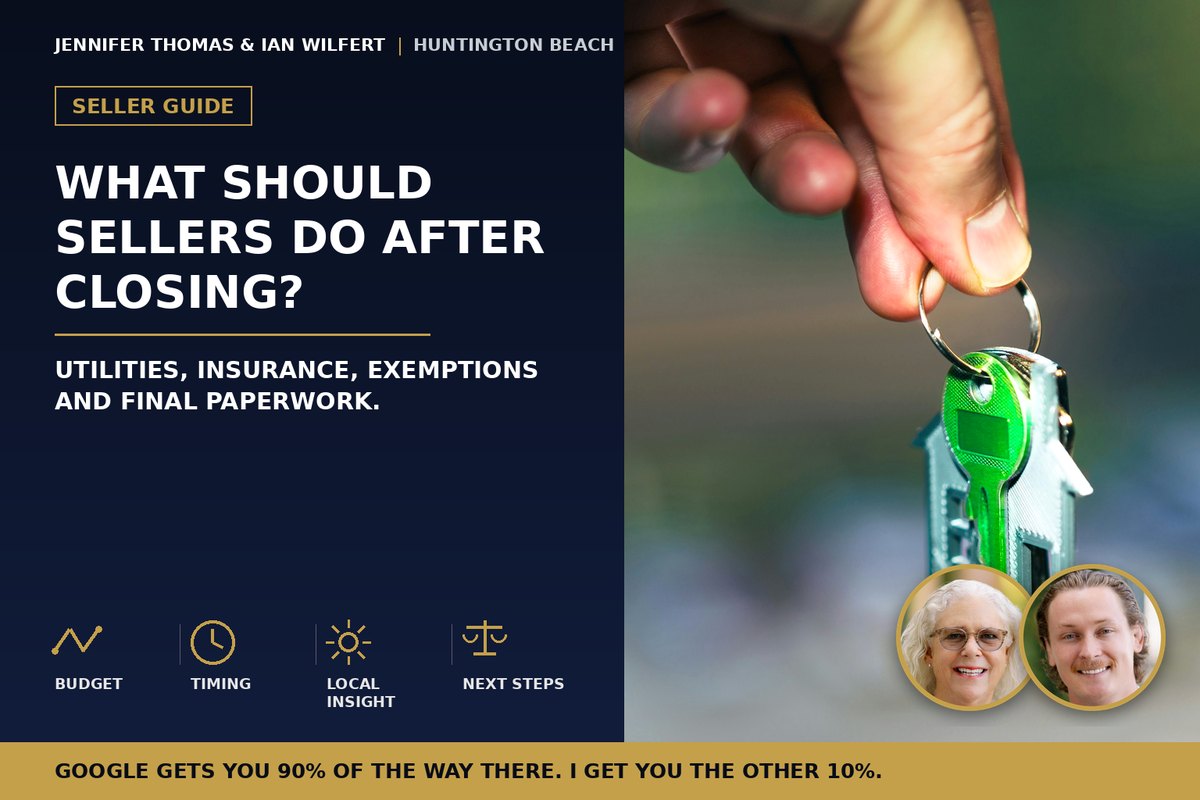
Quick Answer: After closing, confirm with your escrow officer that the deed has recorded before you cancel your homeowners insurance or stop utilities in your name. Then stop or transfer services, forward your mail, wrap up with your HOA, and watch for escrow, lender and insurance refunds. Keep your final closing statement and any Form 1099-S information with your tax records, since you will need them to report the sale and figure any capital gains.
Closing day feels like the finish line, and for most sellers it is. But a short list of tasks in the first few weeks after closing protects you from paying for a house you no longer own, missing a refund in the mail, or scrambling for paperwork at tax time.
Whether you just sold a condo near Pacific City or a family home a few blocks from Central Park, the checklist is much the same across Huntington Beach and the rest of Orange County. Here is what I tell sellers to do once escrow closes.
First, Confirm the Sale Has Recorded
In California, a sale generally closes when the grant deed records with the county. Here that means the Orange County Clerk-Recorder. Your escrow officer will usually confirm recording by phone or email, then send funds to you and to any lenders being paid off.
Do not cancel anything until you have that confirmation in writing. Signing your documents is not the same as closing. Funding and recording can happen a day or more after you sign. If you want a refresher on how those final weeks unfold, here is what happens after you accept an offer.
Check how possession transfers too. Most purchase contracts hand the keys to the buyer at close of escrow, or on a set day after it. If you negotiated a rent-back, you stay in the home for an agreed period after closing, and the rules on insurance, utilities and condition change. My post on seller rent-back after closing covers those details.
Insurance After Closing: When to Cancel and What to Keep
Keep your homeowners policy in force until recording is confirmed and the buyer has possession. Once the home belongs to the buyer, call your insurance agent to cancel. Many insurers refund the unused part of the premium, though how they calculate it varies.
A few situations need extra care:
- Rent-back. The buyer’s policy covers the house once they own it. Your belongings and your liability while you live there may need their own coverage, so ask your agent before closing.
- Condos and townhomes. Cancel your individual condo policy. The HOA’s master policy stays with the association.
- Earthquake or flood coverage. These are often separate policies, so cancel each one on its own.
- Impound accounts. If your insurance and property taxes were paid through your mortgage, your lender should refund any leftover impound balance after the loan is paid off.
My post on paying off your mortgage, HELOC and liens when you sell explains how payoffs and those refunds work.
Utilities and Services to Stop or Transfer
Set stop dates for the day possession transfers, not the day you sign. The buyer’s final walkthrough usually happens shortly before closing, and a dark house with no water helps no one. Many providers let you end service in your name without a physical shutoff, so the buyer simply starts service in theirs. Your last few bills tell you exactly who to call.
| Service | What to do |
|---|---|
| Electricity and gas | End service in your name as of the possession date and give a forwarding address for the final bill. |
| Water, sewer and trash | Request a final reading and final bill for the possession date. |
| Internet, cable and phone | Cancel, and return any rented equipment to avoid fees. |
| Alarm monitoring and smart devices | Cancel monitoring and remove your accounts from doorbells, cameras, locks and thermostats. |
| Solar | Hand over manuals and monitoring logins for an owned system. A leased system should have been transferred during escrow. |
| Gardener, pool, pest control and cleaning | Cancel recurring visits and any autopay. |
| Home warranty | Cancel your own plan. A warranty you paid for as part of the sale belongs to the buyer. |
Mail, Address Changes and Your HOA
File a change of address with the U.S. Postal Service a week or two before you move. Forwarding helps, but it does not last forever. Update your address directly with the places that matter most:
- Your bank, credit cards and any lender still holding a loan
- Your employer and payroll
- The IRS and the California Franchise Tax Board, so tax notices reach you
- The DMV, your auto insurer and your voter registration
- Subscriptions, online shopping accounts and anything on autopay
If you sold a condo or townhome, escrow normally notifies the HOA and prorates the dues, but confirm it happened. Cancel any automatic dues payment. Leave gate remotes, pool keys and parking passes for the buyer, and ask the management company to remove you from their portal and mailing list. If you prepaid dues or an assessment past closing, check your closing statement to make sure you were credited.
Watch for Refunds and Stray Bills
Money can trickle back to you in the weeks after closing. Common sources include:
- Escrow refunds. If a payoff or fee came in lower than estimated, escrow may send you the difference.
- Lender impound refunds. Any leftover balance in your impound account comes back to you after the payoff.
- Insurance refunds. Unused premium from a canceled policy.
- Utility deposits and credits. Final bills sometimes show a credit balance you can request.
Make sure every one of these has your new address. A refund check mailed to the house you sold is easy to lose.
Bills can show up too. County records do not always update right away, so a property tax bill may still arrive in your name after the sale. With the first installment of the Orange County tax year due November 1, check your closing statement to see how taxes were prorated before you pay anything. If escrow already settled your share, call your escrow officer before you pay or forward the bill.
Your homeowners’ exemption ends with the sale. The exemption applies to a home you own and live in, so it stops applying to the house you sold. If you bought another home in California, file a new homeowners’ exemption claim with that county’s assessor. It does not carry over on its own.
Keep Your Closing Paperwork for Tax Time
This is the step sellers most often regret skipping. The sale will matter on your next tax return, and the documents you need are easiest to gather now.
- Final closing statement. Escrow’s final settlement statement shows your sale price, selling costs and payoffs. Ask for the final version, not the estimated one.
- Form 1099-S information. Escrow generally reports the sale to the IRS on Form 1099-S and gives you a copy or the same information. In some cases, such as when the seller certifies the gain is fully excludable, the form may not be filed. Keep whatever you receive.
- California withholding paperwork. If any state tax was withheld from your proceeds, keep the withholding statement escrow gives you, since it is credited when you file.
- Your original purchase records. The closing statement from when you bought helps establish what you paid.
- Improvement records. Receipts and permits for a remodel, new roof or added room can raise your cost basis and lower your taxable gain.
- Disclosures and reports. Keep copies of your disclosures, inspection reports and the purchase contract in case questions come up later.
If you received a Form 1099-S, the IRS generally expects you to report the sale on your return, even if your whole gain is excluded. IRS Publication 523 explains how home sale gains are figured and reported. My post on capital gains and the home sale tax exclusion covers what Huntington Beach sellers should know. A tax professional can tell you how long to keep each record.
What I Tell Sellers After Closing
Make a simple 30-day list and work through it in the first month. Most of these tasks take five minutes each. Skipped, they turn into duplicate bills, a lost refund check or a frantic search for paperwork next spring.
Two loose ends are worth an extra phone call. If a home equity line of credit was paid off in escrow, confirm with that lender that the account is closed, not just at a zero balance. And a few months after closing, check that each paid-off loan’s lien release has recorded with the county. Escrow, title and your lender usually take care of it, but a quick check costs nothing.
Finally, keep one folder, paper or digital, with everything from the sale. When tax season comes, or a question comes up a year from now, you will know exactly where to look.
Key Takeaways
- Confirm the deed has recorded before you cancel insurance or end utilities in your name.
- Time utility and service stop dates to the day the buyer takes possession.
- Update your address everywhere, and watch for escrow, impound and insurance refunds.
- Your homeowners’ exemption ends with the sale, so file a new claim if you bought another California home.
- Keep your final closing statement, Form 1099-S information and improvement records for your taxes.
Frequently Asked Questions
When should I cancel my homeowners insurance after selling?
Wait until escrow confirms the deed has recorded and the buyer has possession. If you are renting back, talk to your insurance agent about the coverage you need while you remain in the home.
Will I get a Form 1099-S after closing?
Usually, escrow reports the sale on Form 1099-S and gives you a copy or the same information. In some cases where the gain is fully excludable, it may not be filed. Keep whatever you receive with your tax records.
What happens to my homeowners’ exemption when I sell?
It ends with the sale of that home. If you bought another home in California, file a new claim with the county assessor where the new home is.
Why did I get a property tax bill for the house I sold?
County records can lag behind a sale. Check your closing statement for the tax proration before paying, and call your escrow officer if your share was already settled.
When will I get my impound account refund?
Your lender refunds any leftover impound balance after the loan is paid off, often within a few weeks. Call the lender if it has not arrived, and make sure they have your new address.
Next Step
If you have just closed, or you are about to, keep this checklist handy for the first few weeks after closing. Reach out if a refund does not show up, a bill lands in your name, or you need a copy of your final closing statement, and I will help you track it down.
Google gets you 90% of the way there. I get you the other 10%.
Message me. You get me, not a team.
Jennifer Thomas and Ian Wilfert are Huntington Beach real estate partners at Seven Gables Real Estate, serving buyers and sellers across Huntington Beach and Orange County. Jennifer Thomas is a Huntington Beach real estate broker with 40 years of experience, over 1,100 closed transactions, and a reputation as one of Orange County’s most trusted listing agents and senior relocation specialists. Ian Wilfert specializes in first time home buyers, guiding clients through every step of the buying process in Huntington Beach and surrounding Orange County communities. Together Jennifer and Ian bring decades of established market knowledge and first time buyer expertise to every client they serve in Huntington Beach and Orange County. For the fastest response, contact Ian directly at 714-887-9560 or ianw@sevengables.com. Jennifer can also be reached at Jennifer@JenniferThomas.com or 714-415-5052. Visit ianwilfert.com. Jennifer Thomas DRE 00931959 | Ian Wilfert DRE 02096787.